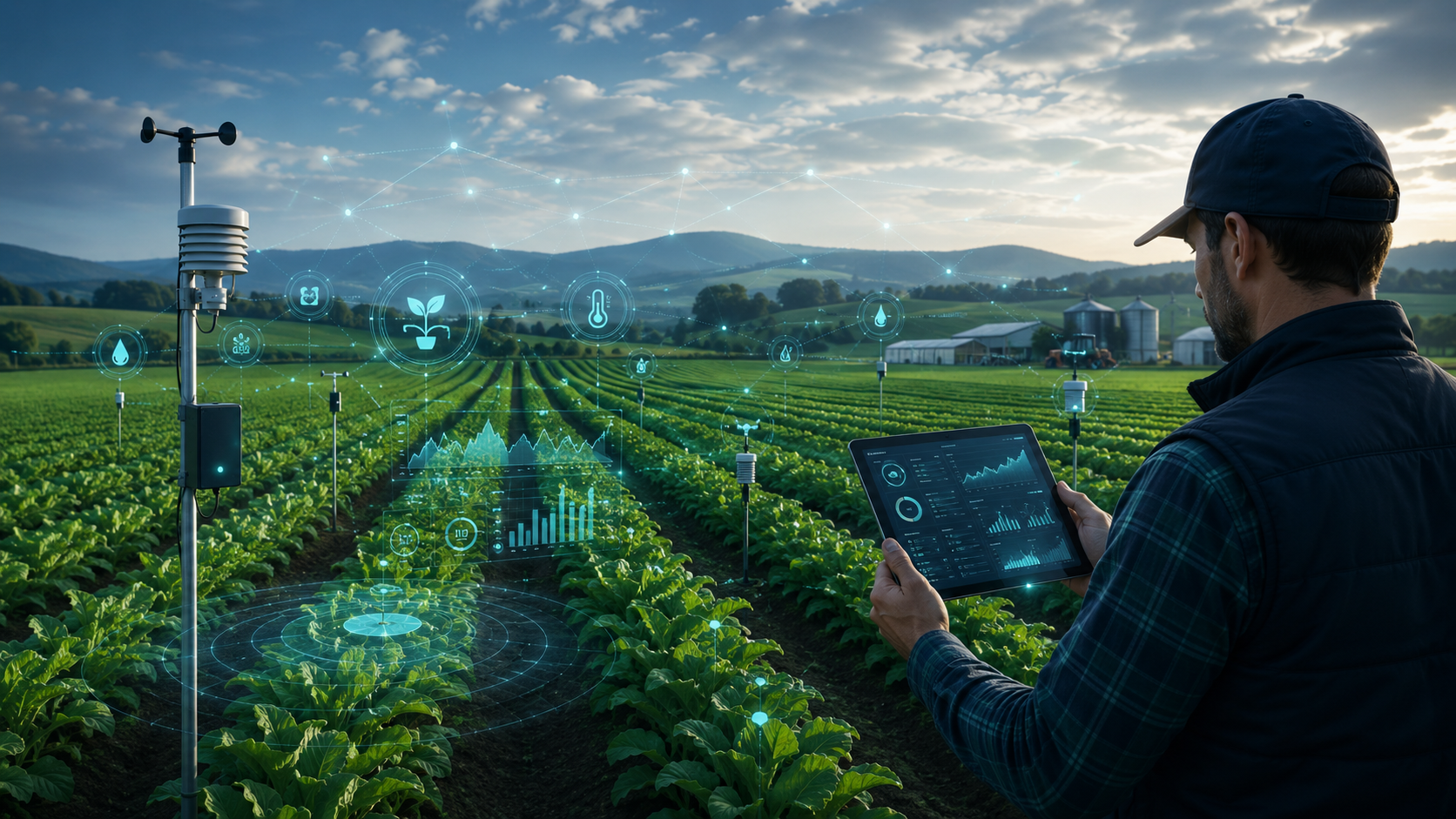
IoT Agriculture & Smart Farming Guide
How connected devices and smart farming platforms are transforming agricultural productivity.
Deployment models, cost analysis and ROI frameworks for IoT agriculture technology.
- IoT deployment models
- Smart farming cost analysis
- Connectivity and infrastructure
- ROI and productivity benchmarks
This guide is part of the Technology Providers intelligence hub on Global Trade Connect.
Intro
The Internet of Things is reshaping how agricultural operations collect data, monitor conditions and make decisions. Connected soil sensors, weather stations, livestock trackers, irrigation controllers, grain storage monitors and supply chain tracking devices are generating real-time data streams that enable more precise, responsive and efficient farm management than was possible even five years ago.
For technology providers, IoT agriculture represents both a significant commercial opportunity and a complex deployment challenge. Connectivity limitations, hardware durability requirements, data integration complexity and the need to demonstrate clear value to conservative agricultural customers all affect how IoT solutions are brought to market and adopted at scale.
For investors, IoT agriculture sits at the intersection of hardware, software and data — a combination that creates complex business models with mixed margin profiles and significant variation in investment quality across different companies and deployment approaches.
This guide provides a practical framework for understanding IoT agriculture technology, deployment models and investment economics for technology providers and investors exploring opportunities through Global Trade Connect.
How IoT is transforming agricultural decision-making
IoT technology transforms agricultural decision-making by replacing periodic manual observation with continuous automated monitoring. Instead of checking soil moisture once a week, a connected sensor network provides real-time data that enables irrigation to be triggered automatically at precisely the right moment. Instead of discovering crop stress during a field walk, multispectral sensors detect early warning signals days before visible symptoms appear.
This shift from reactive to proactive management is the fundamental value proposition of IoT agriculture. The economic benefit depends on how much earlier and better decisions enabled by real-time data translate into yield improvements, input savings and loss reduction in the specific farming context where the technology is deployed.
Jump directly to the section most relevant to your focus.
- How IoT is transforming agricultural decision-making
- Main IoT agriculture technology categories
- Deployment models and connectivity requirements
- Cost and ROI benchmarks for IoT agriculture
- Key challenges in IoT agriculture deployment
- Investment considerations for IoT agritech
- How this connects to Global Trade Connect
Main IoT agriculture technology categories
Soil monitoring sensors
In-field soil sensors measure moisture, temperature, electrical conductivity, pH and nutrient levels at different soil depths. They enable precision irrigation scheduling, fertiliser optimisation and early detection of soil health issues. Sensor networks can cover individual fields or entire farms depending on the scale and granularity of data required.
Weather and microclimate monitoring
Farm-level weather stations provide hyperlocal climate data including temperature, humidity, rainfall, wind speed and solar radiation. This data supports crop disease risk modelling, irrigation scheduling, frost protection and harvest timing decisions that rely on accurate local weather conditions rather than regional forecasts.
Livestock monitoring technology
Connected ear tags, collars and boluses track animal location, movement, temperature, rumination and reproductive status in real time. These systems enable early detection of health issues, more precise breeding management and improved feed efficiency through better understanding of individual animal behaviour and condition.
Irrigation and water management IoT
Smart irrigation controllers use sensor data, weather forecasts and crop models to automate irrigation scheduling. They can reduce water use by 20–40% compared to timer-based systems while maintaining or improving crop yields, making them particularly valuable in water-stressed environments.
Grain storage and post-harvest monitoring
Storage monitoring systems track temperature, humidity and CO2 levels in grain bins and warehouses to prevent spoilage and quality loss. They are especially relevant in emerging markets where post-harvest losses represent a significant proportion of total production value.
Supply chain and logistics IoT
Connected devices track agricultural products through the supply chain from farm to processor or retailer, providing temperature monitoring, location tracking and condition data that supports food safety compliance and quality assurance.
Deployment models and connectivity requirements
Cloud-connected cellular systems
The most common deployment model uses cellular connectivity to transmit sensor data to cloud-based analytics platforms. This model works well in areas with reliable mobile coverage but faces limitations in remote agricultural environments where connectivity is poor or expensive.
LoRaWAN and LPWAN networks
Low-power wide-area network technologies such as LoRaWAN provide long-range, low-power connectivity for agricultural sensors in areas where cellular coverage is limited. These networks can be deployed privately on a farm or accessed through shared public infrastructure where available.
Satellite connectivity
Emerging satellite IoT services are extending connectivity to previously unreachable agricultural environments. While currently more expensive than terrestrial alternatives, satellite IoT is becoming increasingly relevant for large-scale or remote agricultural operations in developing markets.
Edge computing systems
Edge computing processes sensor data locally rather than transmitting it to the cloud, reducing connectivity requirements and latency. This model is particularly suitable for time-sensitive applications such as automated irrigation control or equipment monitoring where real-time response is required.
Cost and ROI benchmarks for IoT agriculture
| IoT System Type | Setup Cost | Annual Running Cost | Key ROI Driver | Payback Period |
|---|---|---|---|---|
| Soil Sensor Network | $3,000–$15,000 | $500–$2,000 | Water and fertiliser savings | 1–3 years |
| Weather Station | $500–$3,000 | $200–$800 | Disease risk reduction | 1–2 years |
| Livestock Monitoring | $5,000–$30,000 | $1,000–$5,000 | Health and breeding efficiency | 2–4 years |
| Smart Irrigation | $5,000–$25,000 | $500–$2,000 | Water cost reduction | 1–3 years |
| Grain Storage Monitor | $2,000–$10,000 | $300–$1,500 | Post-harvest loss reduction | 1–2 years |
| Supply Chain Tracking | $3,000–$20,000 | $1,000–$5,000 | Compliance and quality assurance | 2–4 years |
Key challenges in IoT agriculture deployment
Connectivity infrastructure
Reliable connectivity remains one of the most significant barriers to IoT adoption in agriculture, particularly in emerging markets and remote farming regions. Technology providers need to design solutions that function effectively in low-connectivity environments or invest in connectivity infrastructure as part of their deployment model.
Hardware durability and maintenance
Agricultural environments are harsh. Sensors and connected devices must withstand extreme temperatures, moisture, dust, UV exposure and physical contact with equipment and animals. Hardware failure rates and maintenance requirements significantly affect the total cost of ownership and customer satisfaction with IoT systems.
Data integration complexity
IoT devices generate large volumes of data that need to be integrated with farm management software, financial systems and decision support tools to deliver actionable value. Integration complexity and the lack of common data standards in agriculture create significant friction in IoT deployment and limit the analytical value that customers can extract from their sensor investments.
Farmer adoption and digital literacy
Even technically excellent IoT systems fail to deliver value if farmers do not understand how to interpret the data they generate or how to change management practices in response to sensor insights. Training, ongoing support and intuitive user interfaces are critical success factors that affect both customer outcomes and technology provider reputation.
Investment considerations for IoT agritech
Investors evaluating IoT agriculture companies need to assess the business model carefully because hardware, software and service components create very different margin profiles and investment characteristics.
Pure hardware businesses typically have lower gross margins and higher capital requirements than software businesses, but strong hardware positions can create barriers to entry and provide platforms for recurring software and data revenue. The most attractive IoT agritech business models combine proprietary hardware with high-margin recurring software subscriptions and data services.
Connectivity strategy is an important investment consideration because it affects both the addressable market and the operating cost structure. Companies with technology-agnostic connectivity approaches that work across cellular, LoRaWAN and satellite networks have larger addressable markets than those dependent on a single connectivity technology.
How this connects to Global Trade Connect
This IoT agriculture guide is especially relevant for technology providers and investors exploring smart farming opportunities through Global Trade Connect. IoT technology providers can use this analysis to understand deployment economics and competitive positioning, while investors can use it to evaluate the business model quality and market potential of IoT agritech investments.
This page connects directly to related resources on:
- Precision Agriculture ROI for complementary technology return analysis
- Agritech Valuation Guide for understanding how IoT companies are valued
- Farm Management Software Comparison for software integration context
- Agricultural ROI Calculator for broader investment comparison
- Market Intelligence for sector investment trends
Explore IoT agriculture technology opportunities, smart farming solutions and investment-ready agricultural projects on Global Trade Connect to identify the connected agriculture investments that best match your strategy.