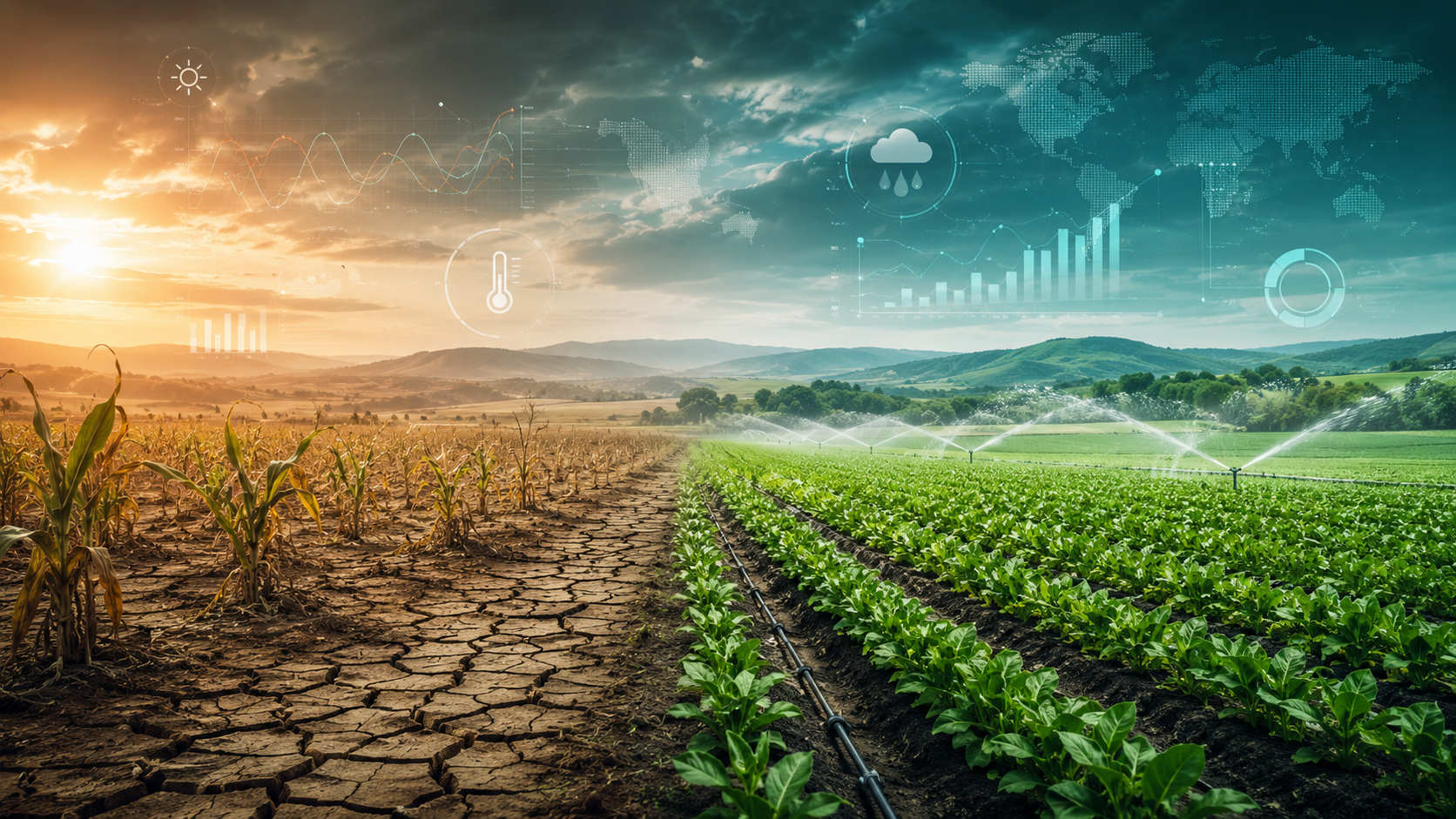
Climate Risk in Agriculture Guide
How climate change affects agricultural investment returns and operational performance.
Risk modelling frameworks, mitigation strategies and investment considerations for climate-smart agriculture.
- Climate risk assessment frameworks
- Investment return impact analysis
- Mitigation and adaptation strategies
- Regional climate risk benchmarks
This guide is part of the Sustainability & Carbon hub on Global Trade Connect.
Intro
Climate change is increasingly recognised as one of the most significant systemic risks facing agricultural investment and operations. Rising temperatures, shifting rainfall patterns, more frequent extreme weather events and growing water stress are affecting crop yields, supply chain reliability and asset values across agricultural markets worldwide.
For investors, climate risk is no longer a distant concern but an immediate factor in portfolio management, due diligence and asset valuation. For farmers and project developers, understanding and managing climate exposure is becoming a prerequisite for accessing financing, insurance and premium market channels.
This Climate Risk in Agriculture Guide provides a practical framework for understanding how climate change affects agricultural investment returns, what risk assessment approaches are most useful and how investors, project developers and farm operators can build climate resilience into their strategies and operations.
This guide is part of the Global Trade Connect Sustainability & Carbon hub, designed to provide actionable intelligence on sustainability themes shaping agricultural investment and operations.
Why climate risk matters for agricultural investment
Climate risk matters for agricultural investment because it affects the fundamental drivers of agricultural return — yield stability, input costs, asset values and market access. A farming operation or agribusiness that performs well under current climate conditions may face significantly different economics as temperature and precipitation patterns shift over the coming decades.
Furthermore, climate risk is increasingly reflected in financing conditions. Banks and institutional investors are incorporating climate risk assessments into their agricultural lending and investment criteria, and businesses that cannot demonstrate climate awareness and resilience planning may find access to capital becoming more difficult and more expensive over time.
Jump directly to the section most relevant to your focus.
- Why climate risk matters for agricultural investment
- Main types of climate risk in agriculture
- Climate risk assessment frameworks
- Regional climate risk profiles
- Mitigation and adaptation strategies
- How investors should approach climate risk in agricultural due diligence
- How this connects to Global Trade Connect
Main types of climate risk in agriculture
Physical risk — acute events
Acute physical risks include extreme weather events such as floods, droughts, heatwaves, cyclones and late frosts that can cause significant and sudden damage to crops, livestock, infrastructure and supply chains. These events are becoming more frequent and severe in many agricultural regions as a consequence of climate change.
Physical risk — chronic changes
Chronic physical risks include gradual shifts in temperature, precipitation patterns, growing seasons and water availability that affect agricultural productivity over time. These changes may be less immediately visible than acute events but can fundamentally alter the economic viability of specific crops and farming systems in affected regions.
Transition risk
Transition risks arise from the policy, regulatory and market changes associated with the shift to a lower-carbon economy. Carbon pricing, deforestation regulations, sustainability disclosure requirements and changing consumer preferences can all affect agricultural business models and investment values in ways that are difficult to predict but increasingly material.
Water risk
Water scarcity, groundwater depletion, changing river flows and deteriorating water quality represent specific climate-linked risks that are particularly relevant for irrigated agriculture and food processing operations. Water risk is often underestimated in investment due diligence but can be a critical determinant of long-term agricultural viability.
Pest and disease risk
Changing climate conditions are expanding the geographic range of agricultural pests and diseases, introducing new threats to farming systems that previously operated outside their reach. This creates new operational risks for crop and livestock producers and increases the complexity of pest management strategies.
Climate risk assessment frameworks
TCFD framework
The Task Force on Climate-related Financial Disclosures provides a widely used framework for assessing and disclosing climate-related risks and opportunities. Agricultural investors and businesses increasingly use TCFD-aligned approaches to structure their climate risk assessments and communicate findings to stakeholders.
Scenario analysis
Scenario analysis models how agricultural assets and businesses might perform under different climate futures, typically including a low-warming scenario, a moderate-warming scenario and a high-warming scenario. This approach helps investors understand the range of potential outcomes rather than relying on a single climate projection.
Physical risk mapping
Geographic information system tools and climate data platforms enable investors to map the physical climate risk exposure of agricultural land assets, identifying areas with high flood risk, drought risk, heat stress risk or water scarcity risk based on current and projected climate data.
Stress testing
Stress testing applies extreme but plausible climate scenarios to agricultural financial models to assess how returns, asset values and debt service capacity would be affected under severe climate conditions. This approach helps identify vulnerabilities that may not be visible under base-case assumptions.
Regional climate risk profiles
| Region | Primary Climate Risk | Secondary Risk | Investment Implication |
|---|---|---|---|
| Sub-Saharan Africa | Drought and water stress | Extreme heat | Irrigation investment critical |
| South Asia | Monsoon variability | Flooding | Drainage and water storage |
| Mediterranean Europe | Drought intensification | Wildfire risk | Crop diversification needed |
| Southeast Asia | Flooding and cyclones | Sea level rise | Elevated land selection |
| North America | Drought in west | Extreme cold events | Geographic diversification |
| Latin America | Deforestation pressure | Drought cycles | Sustainability compliance |
Mitigation and adaptation strategies
Crop diversification
Diversifying across multiple crop types, varieties and growing seasons reduces vulnerability to climate-driven yield shocks in any single crop. Diversified farming systems are generally more resilient to weather variability than monoculture operations focused on a single high-value crop.
Irrigation and water management investment
Investing in efficient irrigation infrastructure, water storage and groundwater management reduces exposure to rainfall variability and drought risk. As a result, irrigation investment is increasingly viewed not only as a productivity tool but also as a climate resilience strategy.
Climate-smart crop varieties
Adopting drought-tolerant, heat-resistant and flood-resilient crop varieties reduces yield vulnerability to climate extremes. Agritech companies developing climate-adapted seeds and genetics are therefore attracting growing investment interest as climate risk awareness increases.
Agricultural insurance
Crop insurance, weather index insurance and revenue protection products provide financial protection against climate-driven income losses. Insurance penetration in agricultural markets remains low in many emerging economies, creating both a risk management gap and a commercial opportunity for agri-fintech and insurance technology providers.
Carbon sequestration and land management
Farming practices that build soil organic matter, improve water retention and increase biodiversity also typically improve climate resilience by creating more buffered and adaptive agricultural ecosystems. Consequently, carbon-smart farming and climate adaptation are increasingly aligned rather than separate strategies.
How investors should approach climate risk in agricultural due diligence
Climate risk assessment should be integrated into agricultural investment due diligence rather than treated as a separate ESG compliance exercise. Practically, this means including physical risk mapping of target assets, scenario analysis of how returns might change under different climate trajectories and assessment of the management team’s climate awareness and adaptation capability.
For longer-term investments such as farmland or infrastructure, climate risk assessment should cover at least a 20–30 year horizon because the compounding effects of gradual climate change are most significant over longer time periods. Short-term financial models that do not account for climate trajectory can significantly overestimate long-term asset values and returns in climate-exposed locations.
How this connects to Global Trade Connect
This climate risk guide is especially relevant for investors and project developers evaluating agricultural opportunities through Global Trade Connect. Understanding climate risk at the asset and portfolio level improves investment decision quality and helps identify opportunities that are well-positioned for long-term performance as climate conditions evolve.
This page connects directly to related resources on:
- Carbon Credits Agriculture for carbon income and sequestration context
- Impact Investing in African Agriculture for ESG investment frameworks
- Agricultural ROI Calculator for investment return comparison
- Agricultural Export Market Analysis by Country for regional market context
- Market Intelligence for sector investment trends
- Organic Certification Guide ← link toevoegen zodra pagina live is
Explore climate-resilient agricultural investment opportunities, sustainable farming projects and ESG-focused solutions on Global Trade Connect to identify opportunities that combine climate resilience with long-term commercial returns.