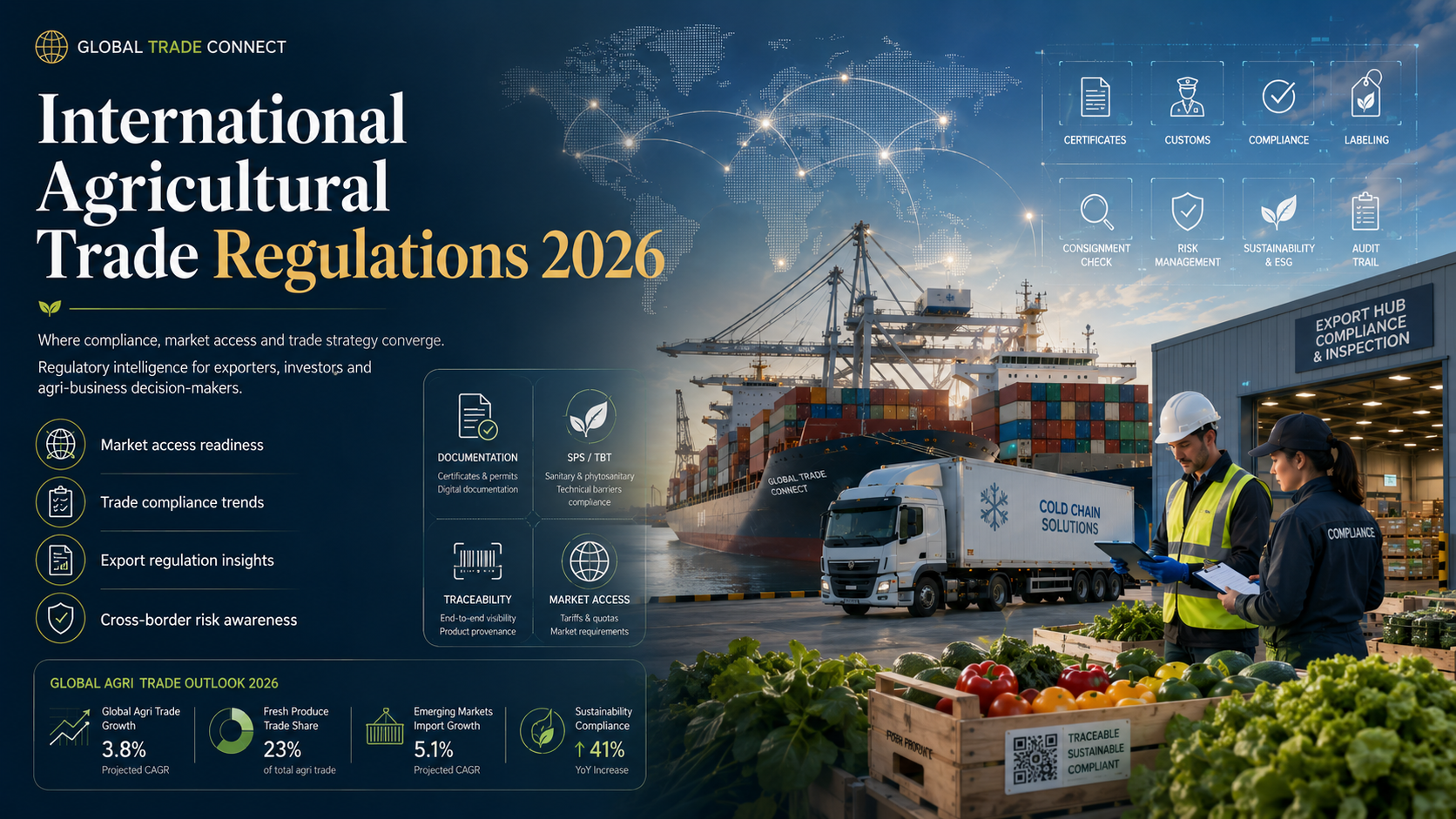
International Agricultural Trade Regulations 2026
Where compliance, market access and trade strategy converge.
Regulatory intelligence for exporters, investors and agri-business decision-makers.
International agricultural trade in 2026 is shaped by a more complex regulatory environment than in previous years. Trade is increasingly influenced not only by tariffs and logistics, but also by technical standards, customs procedures, documentation rules, sustainability requirements and product-specific import conditions that determine whether goods can enter a market smoothly.
For exporters, investors and supply chain partners, this means market access depends on regulatory preparedness as much as on commercial opportunity. A strong product, attractive market and competitive price are no longer enough if compliance systems, traceability, labelling and documentation are weak.
For Global Trade Connect, this topic is highly relevant because agricultural opportunity assessment must include not only demand-side intelligence but also a clear view of compliance exposure, non-tariff barriers and cross-border execution risk. This page provides a practical framework for understanding the main agricultural trade regulation themes shaping 2026.
Why trade regulations matter more in 2026
Trade regulations matter more in 2026 because agricultural exporters are operating in a world of tighter policy controls, more fragmented trade relationships and rising technical barriers. UNCTAD notes that technical regulations now affect roughly two thirds of global trade, increasing compliance costs and creating greater pressure on smaller exporters in particular.
This shift matters because even commercially attractive markets can become difficult to access when certification, origin rules, labelling, inspections or import procedures are not well understood in advance. In agriculture, market access is increasingly tied to documentation quality, operational discipline and regulatory responsiveness
Contents
Jump directly to the section most relevant to your trade or investment focus.
Key regulation areas exporters need to watch
Compliance as a strategic business function
One of the main areas exporters need to watch is the continued rise of non-tariff measures. These include sanitary and phytosanitary rules, technical barriers to trade, registration requirements, labelling rules, packaging standards, documentation demands and licensing requirements that may increase costs or slow down shipments even when tariffs are manageable.
Another important trend is the growing role of sustainability, due diligence and traceability expectations in international agri-food trade. OECD analysis highlights that countries are increasingly using digital tools such as e-certificates, remote audits and traceability systems within SPS and trade facilitation frameworks, making digital compliance capacity more important for exporters.
Trade compliance is no longer just an administrative task handled at the end of the export process. In 2026 it is increasingly a strategic business function that shapes how companies classify products, prepare documentation, manage supplier data, build traceability and coordinate across legal, operations, sourcing and logistics teams.
This is especially important in agriculture because delays, rejections or misclassification can affect perishability, margins, buyer confidence and long-term market credibility. Businesses that treat compliance as part of market-entry strategy are often better positioned to scale into demanding export markets.
Risks for agricultural exporters and investors
How this connects to Global Trade Connect
For exporters, one of the biggest risks is assuming that strong demand automatically leads to successful market entry. In practice, shipments can be delayed, returned or made uncompetitive because of weak traceability, missing certificates, non-compliant labelling, poor classification or failure to meet destination-market requirements.
For investors, regulatory exposure is equally important because it affects scalability, execution risk and market access reliability. A business may look attractive commercially, but if its export model depends on markets with high compliance burdens and weak internal systems, that can become a serious obstacle to growth.
Global Trade Connect can help users interpret agricultural trade regulation trends as part of broader market intelligence and opportunity analysis. This is especially useful for investors, exporters, project developers and technology providers evaluating which products, markets and business models are best positioned for compliant cross-border expansion.
This page should also connect readers to related analysis on Agricultural Investment Returns Analysis 2026 and Impact Investing in African Agriculture, because trade readiness, ESG expectations and investment performance are often interlinked in real agricultural value chains. As the Market Intelligence hub grows, this page can function as the regulatory lens within that wider analysis cluster.
Explore Related Agricultural Investment Opportunities
Explore related opportunity clusters, technology solutions and infrastructure categories on Global Trade Connect to identify the investment models that best match your strategy.