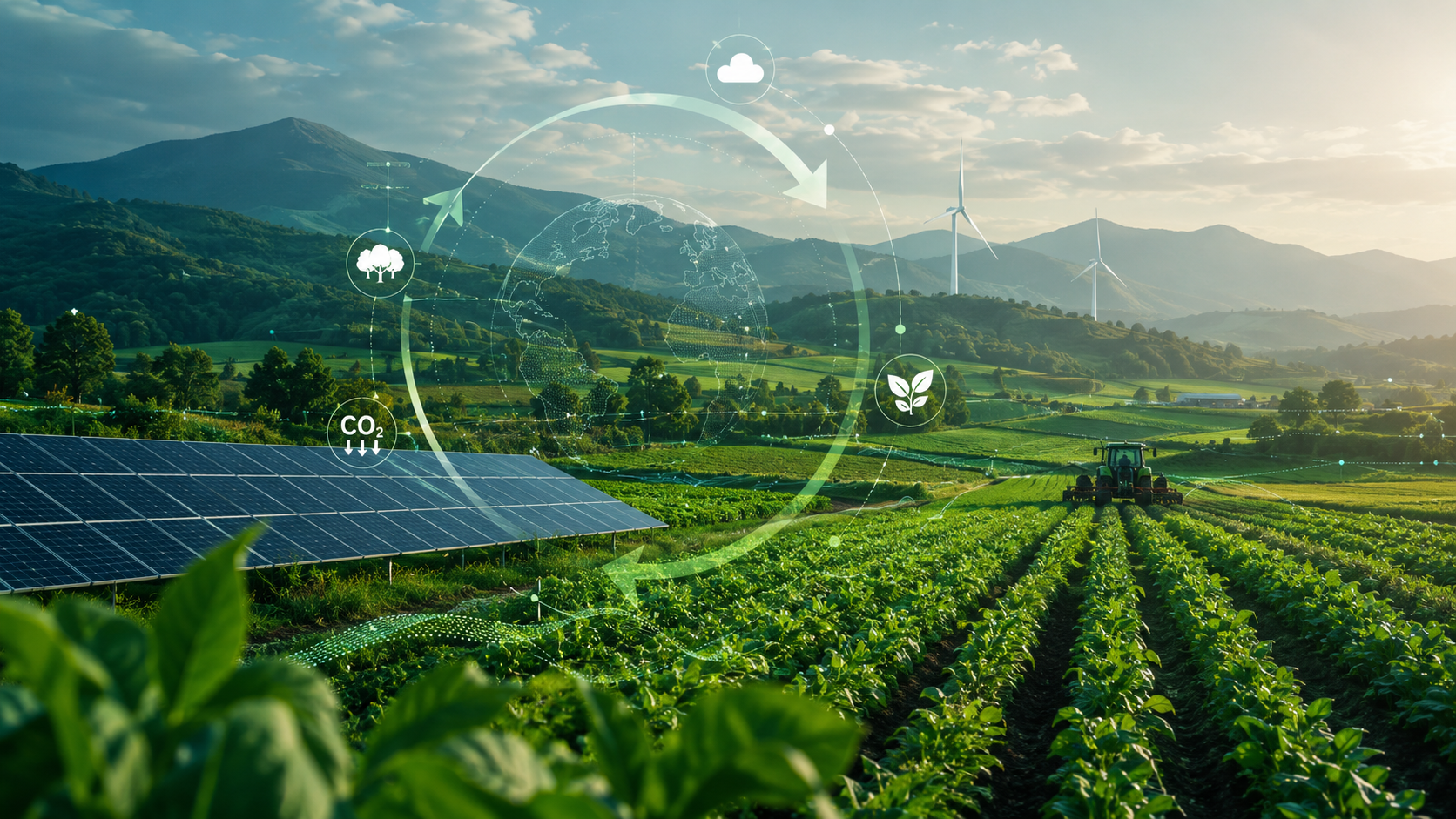
Sustainability & Carbon in Agriculture
Intelligence and tools for carbon markets, climate risk and sustainable agricultural investment.
Practical frameworks for farmers, investors and agritech providers navigating the sustainability transition.
- Carbon credit markets
- Climate risk analysis
- Sustainable investment frameworks
- Certification and compliance intelligence
Intro
Sustainability has moved from a peripheral consideration to a central driver of agricultural investment, financing and market access decisions. Carbon markets, ESG frameworks, climate risk assessments, deforestation regulations and sustainability certification requirements are now shaping how capital flows into agriculture and how agricultural businesses position themselves for long-term commercial success.
For farmers, investors and technology providers, understanding the sustainability landscape is no longer optional. Carbon income opportunities, climate-smart investment frameworks, regulatory compliance requirements and sustainability certification pathways all require practical intelligence that goes beyond general awareness of environmental issues.
Global Trade Connect has developed this Sustainability & Carbon hub to provide investors, project developers, farmers and technology providers with actionable intelligence on the main sustainability themes shaping agricultural investment and operations in 2026 and beyond.
Featured Sustainability & Carbon Guides
Explore our in-depth guides covering carbon credits, climate risk and organic certification in agricultural contexts.
Carbon Credits Agriculture Guide
How farmers and landowners can generate carbon credit income through verified sequestration and emission reduction practices, covering standards, pricing and income potential.
Read the carbon credits guide →
Climate Risk Agriculture Guide
How climate risk affects agricultural investment returns, what risk modelling approaches are used and how investors and farmers can assess and mitigate climate-related exposure.
Read the climate risk guide →
Organic Certification Guide
Practical guide to organic certification standards, costs, requirements and market premiums for farmers and agribusinesses considering certification as a commercial strategy.
Read the organic certification guide →
Why sustainability matters for agricultural investment in 2026
Sustainability considerations are increasingly embedded in investment decision-making across all major asset classes including agriculture. Institutional investors managing large portfolios are under growing pressure from their own stakeholders to demonstrate that their agricultural investments meet ESG criteria, comply with environmental regulations and contribute positively to climate and food system outcomes.
Furthermore, regulatory frameworks are tightening globally. The EU Corporate Sustainability Reporting Directive, the EU Deforestation Regulation, evolving carbon border adjustment mechanisms and expanding national carbon pricing schemes are consequently creating new compliance obligations that affect agricultural businesses operating in or supplying international markets.
For commercial agricultural businesses, sustainability performance is therefore increasingly linked to market access. Retailers, food processors and institutional buyers are imposing sustainability requirements on their supply chains, and businesses that cannot demonstrate compliance with these requirements risk losing access to premium markets regardless of the quality or price competitiveness of their products.
Key sustainability themes in agriculture in 2026
Carbon markets and carbon income
Voluntary and compliance carbon markets are creating new income streams for farmers and landowners who implement practices that sequester carbon or reduce agricultural emissions. However, market complexity, verification costs and price volatility mean that carbon income is not automatic and requires careful evaluation of project economics before committing to a carbon programme.
Climate risk and resilience
Climate change is increasing the frequency and severity of weather events, shifting agricultural suitability zones and creating new operational risks for farming businesses and their investors. Understanding climate risk at the asset and portfolio level is becoming a standard part of agricultural due diligence.
Sustainable certification and market access
Organic, Rainforest Alliance, GlobalGAP, Fairtrade and other sustainability certifications provide market access to premium buyers and retail channels. The economics of certification depend heavily on the price premium achievable in target markets relative to the costs of compliance and ongoing certification.
ESG and impact investing
ESG-aligned investors are allocating increasing amounts of capital to agricultural businesses that can demonstrate measurable environmental and social outcomes alongside financial returns. Understanding what ESG frameworks require and how agricultural businesses can position themselves for impact investment is a growing strategic priority.
Deforestation and supply chain due diligence
New regulations including the EU Deforestation Regulation are requiring companies to demonstrate that their agricultural supply chains are free from deforestation and forest degradation. This is creating significant compliance obligations for agricultural exporters, processors and investors with exposure to affected commodities and geographies.
How this hub connects to Global Trade Connect
The Sustainability & Carbon hub is designed to work alongside other resources available through Global Trade Connect. Investors can combine the guides in this hub with Market Intelligence reports on investment returns and sector dynamics, and use Investment Tools calculators including the Carbon Income Calculator to model specific sustainability investment scenarios.
Project developers seeking sustainability-linked investment can use these guides to understand what ESG investors look for, how carbon projects are structured and what certification pathways are most relevant for their specific agricultural context. Technology providers can use the hub to understand the sustainability requirements that their customers and partners increasingly need to meet.
Explore sustainable agricultural investment opportunities, carbon-aligned projects and ESG-focused agritech solutions on Global Trade Connect to identify opportunities that combine sustainability performance with long-term commercial returns.